

Escape Rooms for Couples: The Ultimate Date Night Guide
September 29, 2026
The Best Halloween Things to Do in Albuquerque This October
October 23, 2026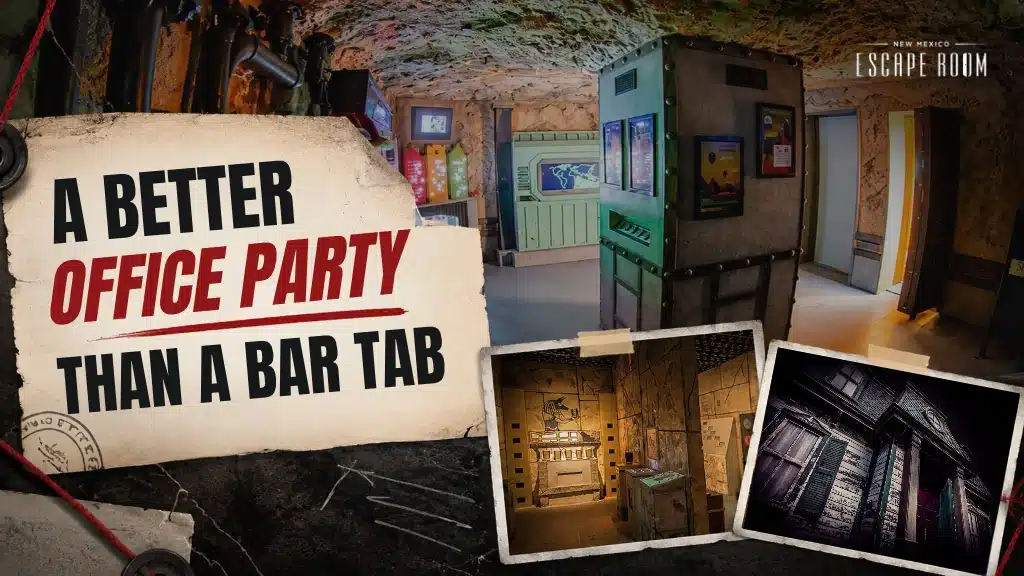
Why an Escape Room Makes a Better Office Party Than a Bar Tab
Every year, someone in the office gets tasked with planning the end of year party. And every year, the result is roughly the same. A restaurant booking, a drinks tab, a few hours of polite conversation, and a quiet agreement that it was fine but nobody is quite sure why they went.
The problem is not the budget or the venue. The problem is the format. A passive social event asks people to connect through conversation alone, which works well for some and badly for others. An escape room asks people to connect through a shared challenge, which works for almost everyone regardless of personality type or seniority.
Here is why the format holds up as a Q4 corporate event, and what makes it genuinely different from the options most companies default to.
What Is Actually Wrong With the Standard Office Party
The standard office party format has a few structural problems that most event planners recognize but rarely address.
It rewards extroverts and punishes introverts. A networking-style event or a dinner where conversation is the only activity puts quieter employees in a position where they either perform sociability or stand at the edge of the room. Neither outcome builds genuine connection.
Hierarchy does not disappear at a bar. Senior staff tend to cluster together. Junior employees navigate the room carefully. The informal setting softens the edges slightly but the organizational structure remains visible throughout the evening.
Nothing actually happens. A great corporate event produces a shared memory. A dinner or drinks evening produces a pleasant but largely forgettable few hours. Ask most people what they remember about last year's office party and the answer is usually not much.
Inclusion is harder than it looks. Events centered on alcohol exclude employees who do not drink. Late evening events exclude parents and carers. High-noise environments exclude people with hearing difficulties or sensory sensitivities. The default format tends to work well for one segment of the team and moderately for the rest.
Why an Escape Room Solves Most of These Problems
An escape room does not fix everything, but it addresses the structural issues above more effectively than most alternatives.
Everyone has a role. Inside an escape room, the team succeeds or fails based on collective contribution. There is no passenger seat. The quietest person in the room often makes the most important discovery of the session because they are searching carefully while louder voices are debating the wrong puzzle. That reversal of the usual office dynamic is one of the more valuable things the format produces.
Hierarchy flattens in a useful way. A senior manager who is poor at spatial puzzles and a junior analyst who spots patterns quickly will perform very differently inside an escape room than they do in a meeting room. That shift in dynamic does not undermine authority. It creates a moment where people see each other differently, which tends to have a positive effect on working relationships afterward.
Something actually happens. A team that escapes with thirty seconds left has a specific shared story. A team that fails on the final puzzle has an even better one. Either outcome produces a memory that people reference for months, which is considerably more than most office parties manage.
It is genuinely inclusive. Escape rooms do not require physical fitness, alcohol consumption, or extroversion. They work for mixed age groups, mixed ability levels, and people at every point on the introvert-extrovert spectrum. The format is also fully accessible for most participants, and most venues can advise on room suitability for groups with specific needs.
Escape Room vs Other Popular Office Party Formats
It is worth being direct about how escape rooms compare to the alternatives that come up most often in Q4 corporate event planning.
Vs. Restaurant dinner: A dinner produces conversation. An escape room produces collaboration and a story. Both have value, and combining them, dinner after the room, tends to produce a better evening than either alone.
Vs. Bowling or mini golf: Competitive sports formats work well for some groups but create a visible performance gap between strong and weak players. An escape room distributes contribution more evenly because different puzzle types reward different skills.
Vs. Cooking class or workshop: Skill-based workshops are popular and generally well received, but they tend to run in parallel rather than collectively. People learn alongside each other rather than with each other. The collaborative pressure of an escape room produces stronger bonding.
Vs. Drinks and networking: The weakest format for genuine connection. Useful for large corporate events where the goal is circulation rather than team cohesion, but a poor choice for a team that already works together and needs to deepen existing relationships rather than make new ones.
What Makes a Corporate Escape Room Event Work Well
The experience itself is only part of what makes a corporate escape room event successful. The planning around it matters as much as the room.
Group size and room selection. Most escape rooms are designed for four to eight players. For larger corporate groups, venues with multiple rooms can run parallel sessions simultaneously, turning the event into a competition between departments or teams. That competitive element works particularly well for Q4 events where the goal is energy and engagement rather than quiet reflection.
Timing within the workday. A lunchtime or late afternoon booking avoids the late-evening access problem that affects parents, carers, and employees with long commutes. A 3pm session followed by drinks or dinner afterward tends to produce better attendance and better energy than an 8pm booking that requires people to stay in the city.
The debrief. The most underused part of any corporate escape room event is the conversation that happens afterward. What worked? Who stepped up unexpectedly? Where did the communication break down? Those conversations are more honest and more useful than a formal team feedback session because they are grounded in something everyone just experienced together. Building in thirty minutes for that debrief, over food or drinks, turns a fun event into something with lasting value.
Private booking. For a corporate event, a private booking is non-negotiable. Mixed public sessions change the dynamic completely and remove the team-specific value the format is supposed to deliver. Any venue worth booking for a corporate group will offer private sessions as standard.
When to Book for Q4
October and November are the heaviest booking months for corporate escape room events. HR teams and event planners who leave Q4 planning until late November find that the best slots are already gone.
For end of year events, the practical window is mid-October through the first two weeks of December. After that, the holiday period compresses schedules and attendance becomes unreliable.
For teams planning an employee appreciation event or a pre-Christmas outing, booking six to eight weeks in advance is the safer approach. It also allows time to communicate the event properly to the team, which affects turnout more than most planners expect.
A Practical Q4 Corporate Event Format
For teams that want to use an escape room as the anchor of a Q4 event without it feeling rushed, this structure works well:
Book a private session for the group, split into teams of five to seven if the group is larger than eight. Run the sessions simultaneously if the venue has multiple rooms. Debrief over drinks or a meal immediately after. Keep the evening open-ended rather than over-scheduled.
The total event runs two to three hours depending on the group size and what follows the room. It fits into a working afternoon or an early evening without requiring people to rearrange their whole week.
Frequently Asked Questions
Are escape rooms suitable for all employees?
Yes. Escape rooms are suitable for employees across different age groups, seniority levels, and personality types. They require no special knowledge or physical fitness, and the difficulty level can be tailored to suit your team's experience and abilities.
How many people can do a corporate escape room event?
Most escape rooms accommodate four to eight players per session. Venues with multiple rooms can host larger corporate groups through parallel sessions. Some venues also offer conference or gathering spaces for pre-event briefings and post-event celebrations.
Is an escape room better than a team building workshop?
Both offer different benefits. Workshops focus on structured learning, while escape rooms provide a hands-on, interactive experience. For corporate events focused on team bonding, employee morale, communication, and fun, escape rooms are an engaging alternative to traditional team-building activities.
How much does a corporate escape room event cost?
The cost depends on the venue, group size, session duration, and any additional facilities required. Many venues offer corporate packages, group discounts, and private bookings. For larger teams, ask about packages that include multiple rooms and dedicated event spaces.
Do we need prior escape room experience?
No prior experience is necessary. Most venues offer rooms with different difficulty levels and can recommend the best option for your team. First-time participants can enjoy the experience with guidance and hints from the game master, making it accessible and enjoyable for everyone.
Your Team Deserves Better Than Another Bar Tab
If you are in Albuquerque and want your Q4 event to actually mean something, New Mexico Escape Room runs private corporate sessions across six themed rooms with capacity for groups of all sizes. Slots during October and November go fast. Book before the good ones are gone.